

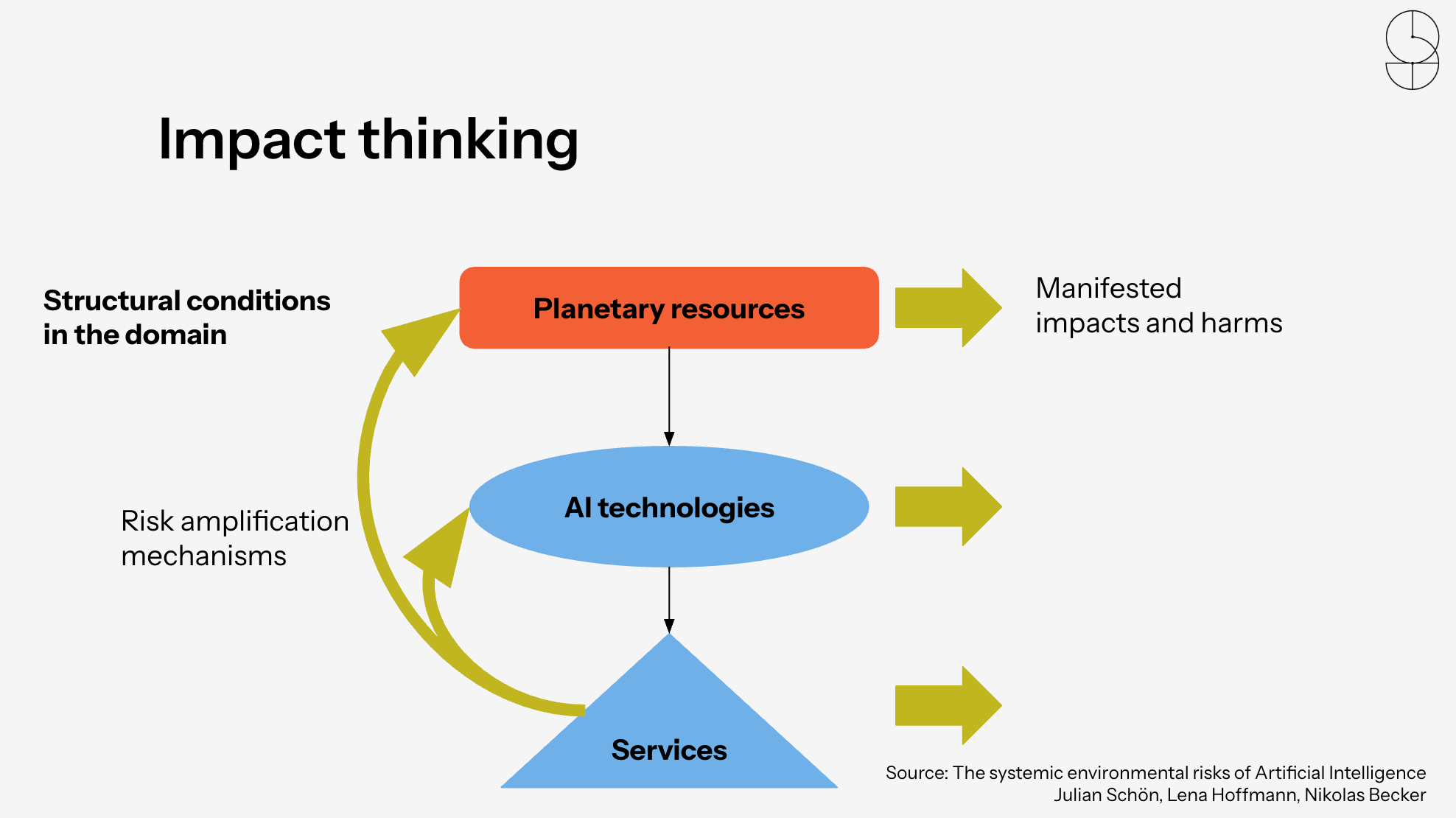
Artificial intelligence is usually talked about as software. But every model depends on a physical system: minerals and specialised equipment, chips and data centres, electricity and water. Those dependencies also affect the places and people around them.
That wider view treats AI as planetary-scale infrastructure: an interconnected system that relies on finite materials, land, energy and water, as well as the organisations and rules that shape how those resources are used.
Seen at that scale, questions that are often dealt with separately turn out to depend on many of the same parts of the system. Decisions about computing capacity affect demand for energy, water and infrastructure; decisions about access shape who can develop and deploy new tools. Different actors may want different things, but their choices still meet in the same system. They need enough of a shared picture to see where interests align, where they conflict, and where coordination is needed.
The problem is that nobody has the full view. Regulators, companies, researchers, journalists and campaigners each hold pieces of it, often collected for different reasons and described in different ways.
We wanted to understand how those different pieces could be brought together into a clearer picture.
One morning, three themes
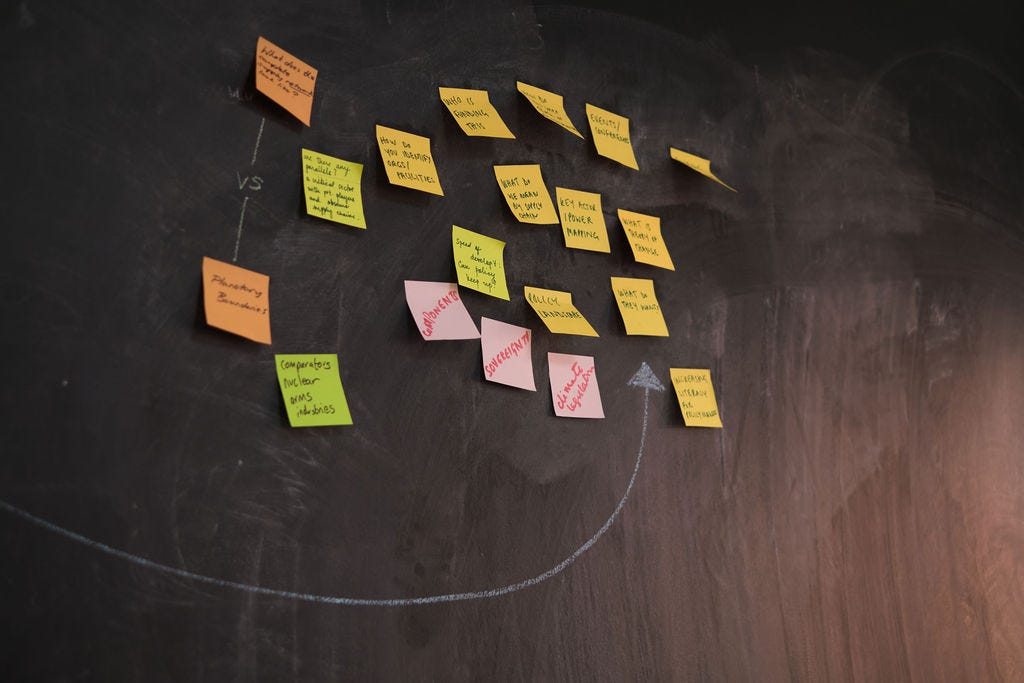
At the end of September, we gave ourselves a morning to explore what it would take to join some of those pieces up.
We had a useful precedent.
In sectors like clothing, timber and minerals, better information is being used to trace products back to factories and places of origin, enforce rules on forced labour or deforestation, assess risks, and understand where supply might be disrupted.
Over time, that has meant moving beyond glossy reports to structured data: named facilities, stable identifiers, traceable inputs and outputs, and claims that can be checked across systems.
We wanted to understand how far that approach could take us with AI. What would need to be visible for people to understand the system, act on risks, and make better decisions – and who would need to share what, with whom, and in what form?
We split into small groups and took several different routes into the question. Over a few hours, people tested a UN supply-chain standard against a real AI model, analysed fourteen model cards, mapped who needs information about supply chains, and explored funding to the transparency of the AI supply chains.
By lunchtime, we were starting to see a familiar pattern. Seeing how the system fits together depends on information being described consistently, connected across organisations, and shared in ways that match what different people actually need to do.
Can an existing supply-chain standard describe an AI model?
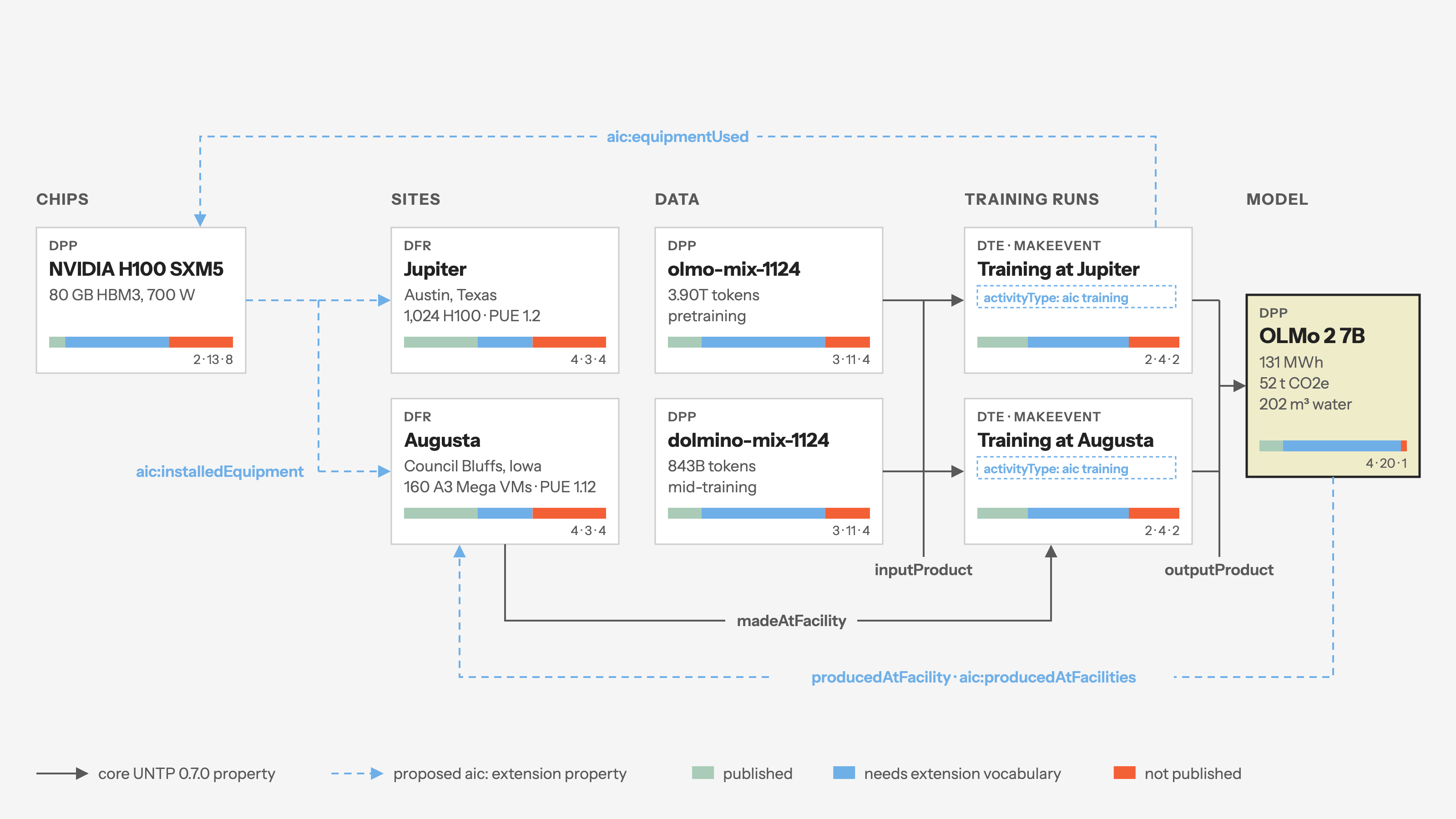
The UN Transparency Protocol (UNTP) was designed to describe supply chains for goods like batteries and textiles. It works through four building blocks: passports for products, records for facilities, events that show how inputs become outputs, and credentials for verified claims.
One experiment tested UNTP against OLMo 2 7B, a model from the Allen Institute for AI. OLMo’s developers publish enough information about its data, training, compute and infrastructure to follow much more of the chain than is possible for most models.
The experiment showed that UNTP could already describe much of OLMo’s supply chain, even though it wasn’t specifically designed with AI in mind. Its existing building blocks covered the main parts of the chain, from infrastructure and training data through to the finished model. The same model passport could also bring together information about who produced the model and where, alongside water use, energy use and emissions.
But we found a few gaps that would require a specialised extension to UNTP. Some AI-specific concepts – such as training data, compute use, and model parameters – need to be described in a standardised way. Other gaps were about disclosure and independent verification: in OLMo’s case, data on individual training runs is missing and much of the disclosed information is self-reported.
For this test case, we found that the basic structure was already there. The next step is to test what would need to be described differently for AI supply chains, and what information needs to be made available in the first place.
Can the information be connected?
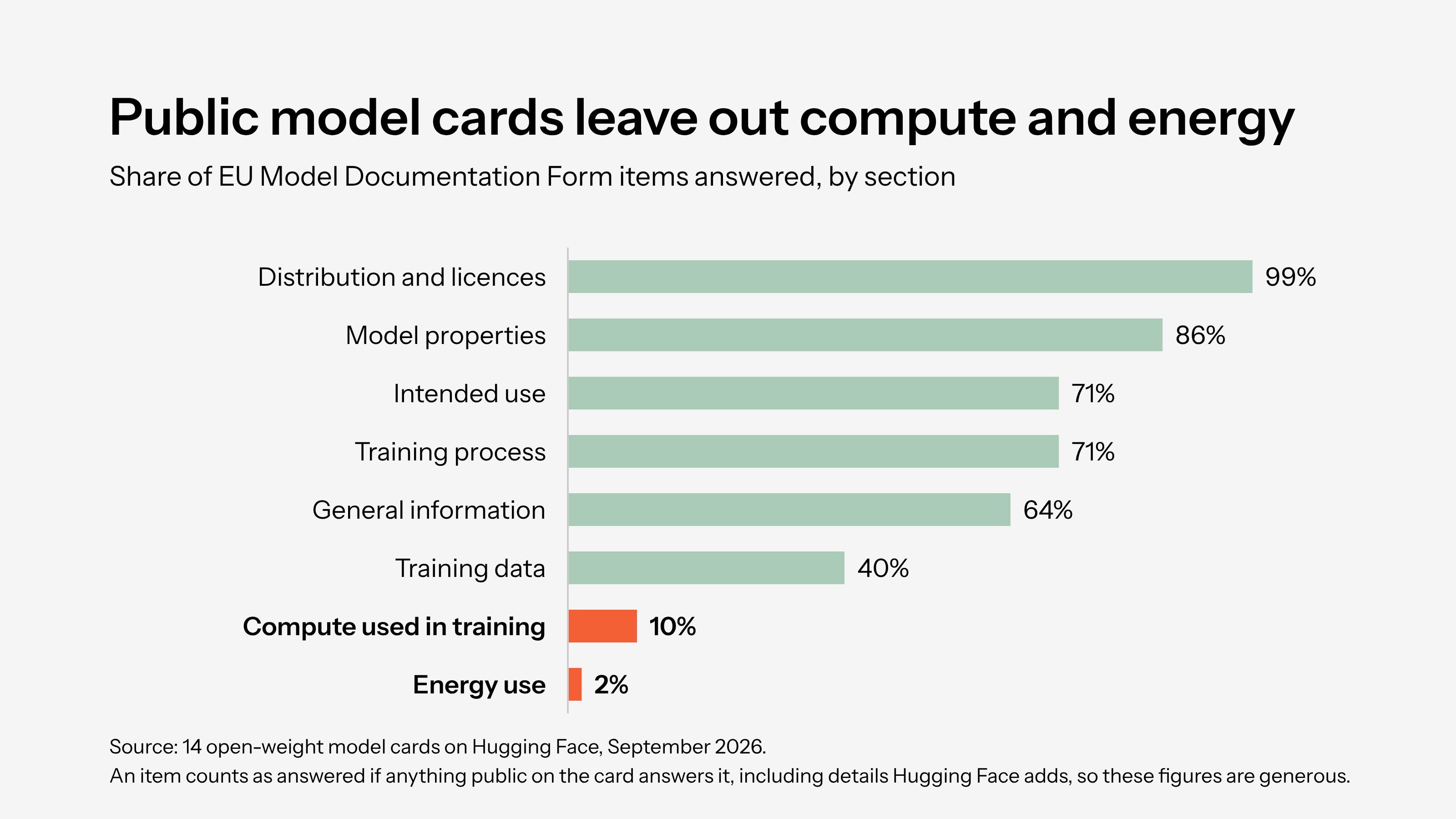
Another route into the problem was model documentation, so we also looked at fourteen model cards from Hugging Face. Model cards document things like how models were trained, what data they used and how they are intended to be used.
We found plenty of useful information, but it was difficult to compare or connect across models. Our quick analysis found that much of the important detail was described as prose, and only 17% of the information disclosed was available as machine-readable metadata. The trail between one model and the models or data it was trained on often broke, too.
Once you move beyond a single model, those limits become much more significant. Comparing models, tracing dependencies or combining model information with data about infrastructure, ownership or impacts all depend on being able to connect records reliably.
A useful picture of the system depends on being able to follow information from one part of it to another. That means consistent fields, clear relationships and records that can be connected across models, organisations and infrastructure.
Who needs information – and what for?
Other experiments approached the question from a different angle: even if information can be described and connected, what gets made visible in the first place, for whom, and what are they trying to do with it?
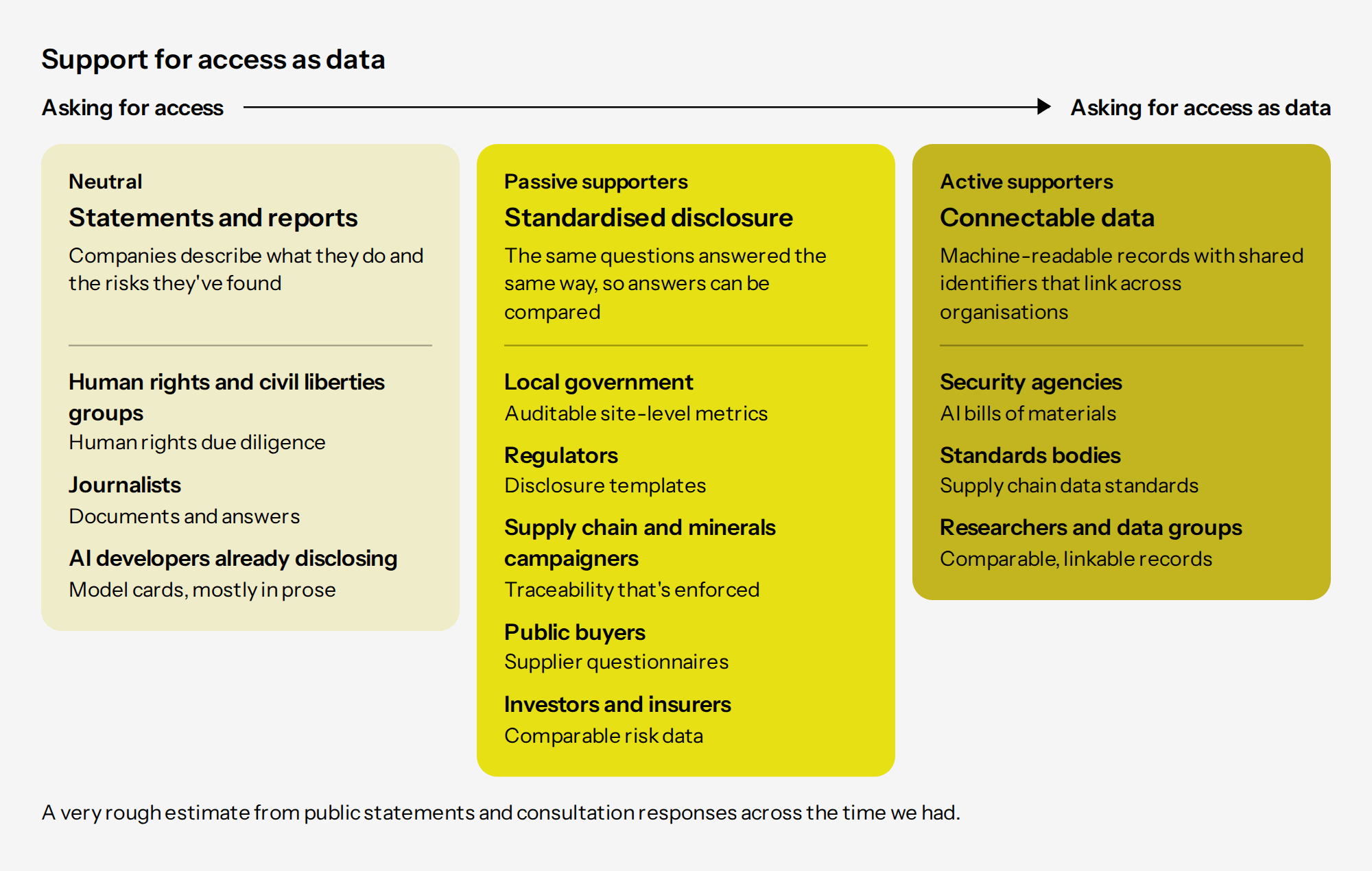
One exercise mapped who has a stake in information about AI supply chains, why, and where they stand on disclosing it. Support turned out to be broad. Amnesty International has traced human rights risks along the supply chain, from chipmakers to data annotators. Global Witness has warned that AI demand could deepen conflict over coltan. And the UK’s Local Government Association has asked for site-level data on data centres that councils can verify.
But the groups pushing hardest for visibility mostly aren’t the ones who hold the information, and resistance to disclosure is concentrated among those who do. In between sits a large undecided group, including public buyers, standards bodies and investors, whose questions are practical: can the information be compared, trusted and used?
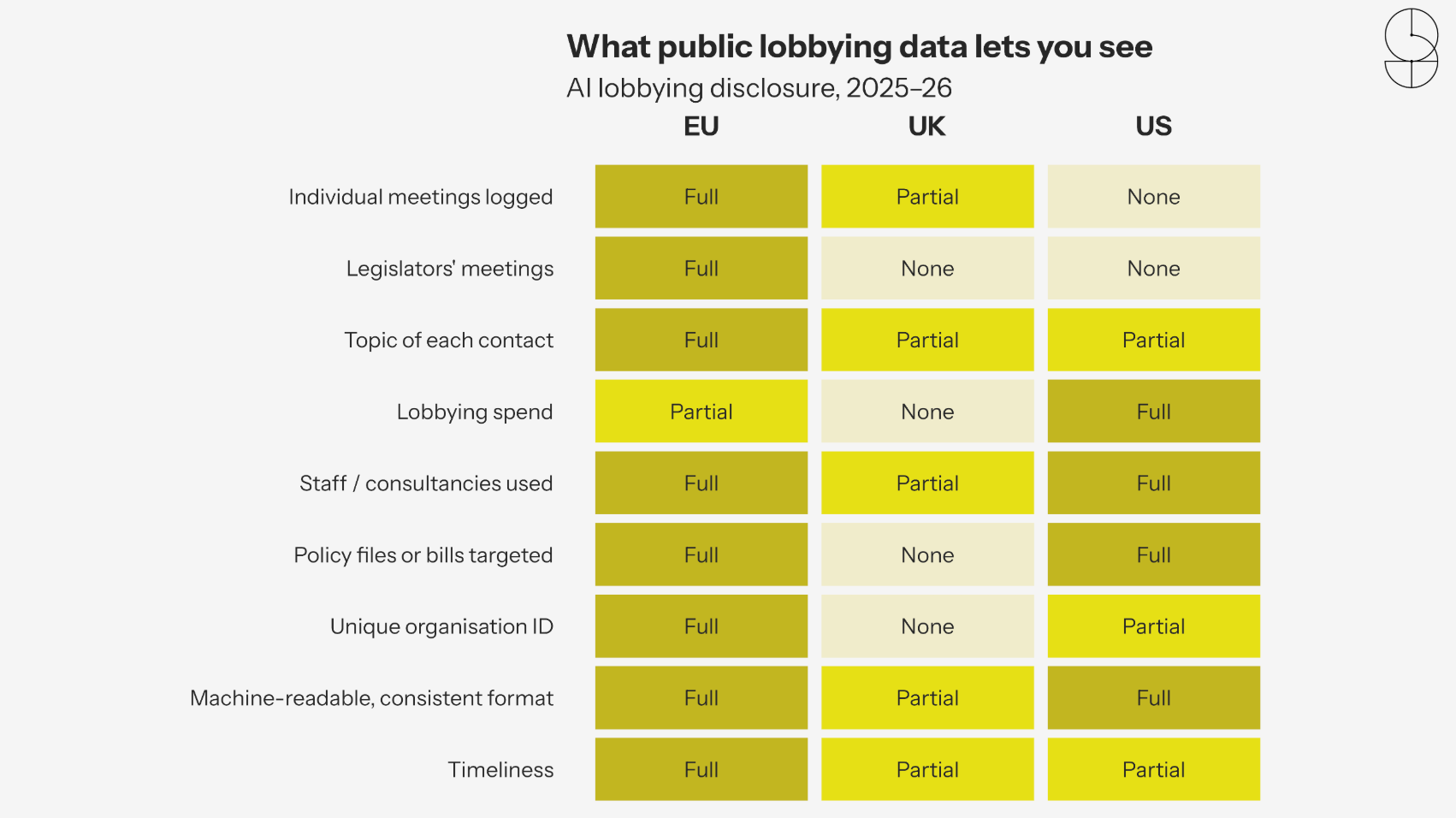
We also compared lobbying disclosure around AI regulation in the EU, UK and US. In the public data the team compared, the EU made it possible to connect organisations with meetings and policy interests, and gives every organisation a unique identifier. The US discloses spending and the bills being lobbied, but not meetings. And the UK logs some meetings, but no spend, no bills targeted, and no organisation identifiers.
A separate group looked at a different relationship: who funds the organisations working on AI supply chain transparency?
The information was publicly available, but difficult to connect. Each source described the same funding in its own way, and organisations weren’t consistently identified, so a lot of time was spent interpreting and matching records.
We modelled what we found using the 360Giving Data Standard, a structured way of describing data about grant-making. What was missing were some of the connections: shared identifiers for organisations, and clearer information about how funding moved between them.
That points to a wider design question: which parts of the ecosystem should be visible, and how?
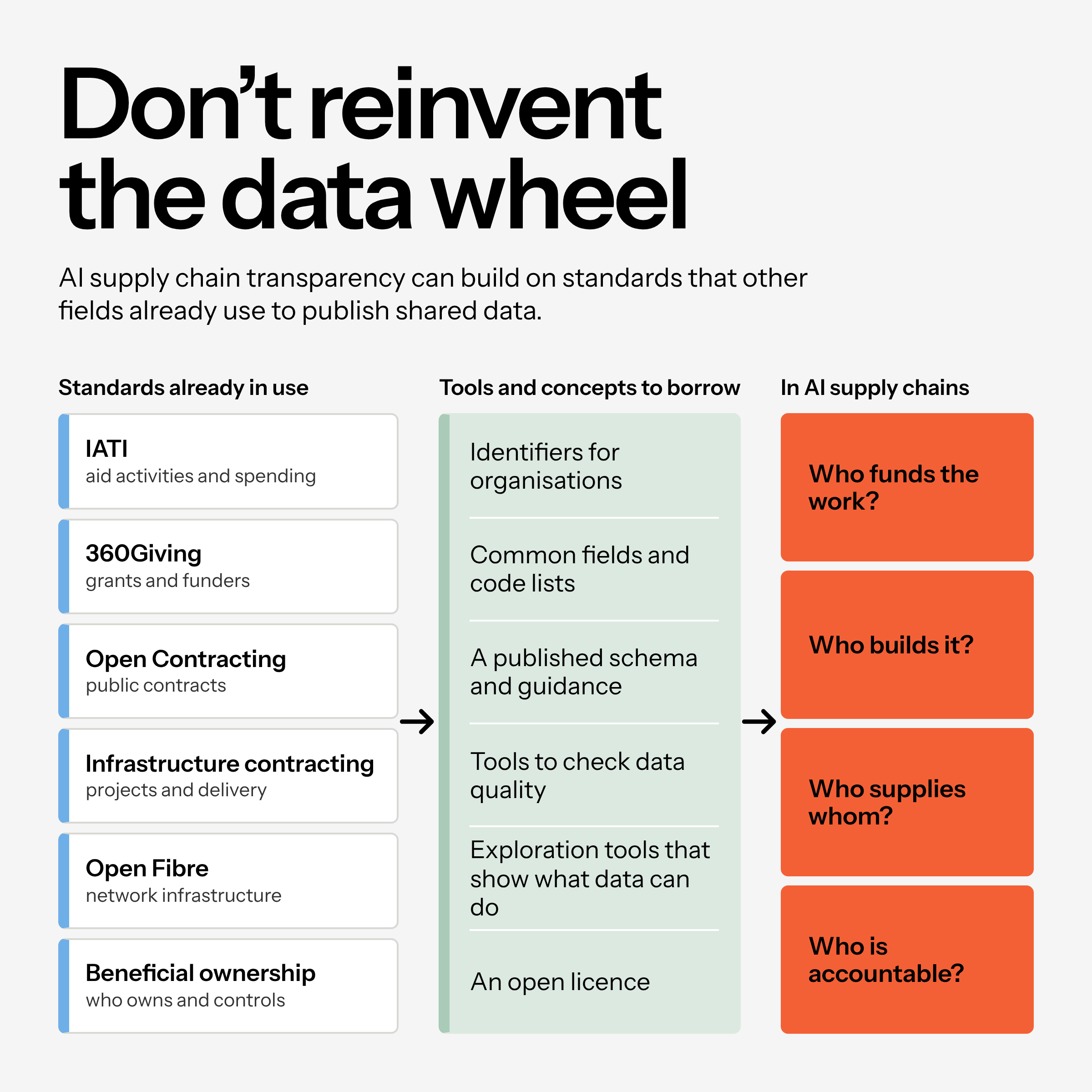
There is already a strong base of standards and approaches for AI supply chain transparency to build from.
ODS has worked on this in other fields, where information from different organisations only becomes useful together when there is enough common structure to connect it across datasets and systems.
Each standard solves different problems, but they share the same foundations: information from different organisations becomes more useful when there is enough common structure that relationships can be followed across different datasets and systems.
All three experiments brought us back to a familiar question: who should be able to find out what, and what do they need to do with the answer?
That determines what needs to be recorded, how records need to connect, and who needs access. A disclosure system is most useful when it lets people follow the relationships they need to make a decision, check a claim, or hold someone to account.
So how far are we?
Closer than we expected in some places. Further than we expected in others.
Taken together, the morning gave us a clearer sense of what useful AI supply-chain data would need: shared ways to describe the system, records that can be connected across it, visibility designed around the decisions people need to make.
One caveat: most of our morning’s work gravitated towards models, model cards and funding, leaving the physical layer largely unexplored. That isn’t because the data isn’t there – in some places, it may actually be better mapped. But the morning only stretched so far, and testing that part of the chain feels like an obvious next step.
There is already plenty to build on. There are standards, datasets and disclosure practices to build on. The work now is to connect them around real questions and decisions, and to be deliberate about what different organisations need to see and understand about one another.
The next question is where a better-connected view of the AI supply chain would actually change what someone can do.
If there’s a part of the AI supply chain you’re trying to understand, trace or make more useful, we’d like to compare notes.
Tell us what you’re working on →
ODS is a worker-owned consultancy specialising in data infrastructure, governance and standards for the public good. We make data work across boundaries, finding practical ways for people, systems and organisations to work together.